Post, STEM & Creative Building Toys
The Architecture of Play: Why Magnetic Tiles are Essential for STEM
May
The Architecture of Play: Why Magnetic Tiles are Essential for STEM
In the rapidly evolving landscape of modern education in 2026, the acronym STEM (Science, Technology, Engineering, and Mathematics) has become a guiding light for parents and educators seeking to prepare children for a future defined by innovation. While many STEM tools focus on complex coding or expensive digital interfaces, one of the most effective ways to introduce these foundational concepts is through open-ended, tactile construction. Specifically, magnetic tiles for kids STEM learning have emerged as a revolutionary tool that bridges the gap between simple block play and complex geometric engineering. They offer a physical sandbox where creativity meets the invisible, persistent laws of physics.
Unlike traditional wooden blocks that rely solely on gravity and friction, magnetic tiles utilize powerful internal magnets to snap together effortlessly. This unique feature allows children to build tall, gravity-defying structures that would be impossible with standard bricks. By engaging with these colorful, translucent shapes, kids aren’t just “playing”—they are conducting real-time experiments in structural integrity, magnetic polarity, and spatial geometry. For a child in Da Nang or anywhere in the world, these tiles turn the living room floor into a high-stakes design studio.
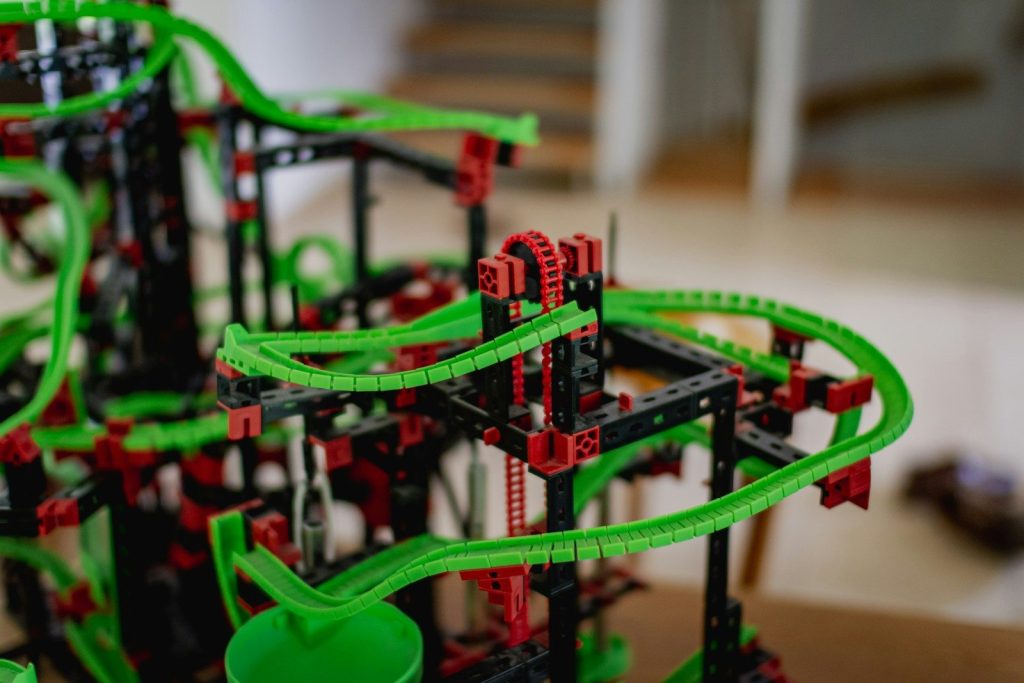
Magnetic tiles allow children to visualize complex 3D structures through simple, colorful shapes.
From 2D Shapes to 3D Masterpieces: The Geometric Evolution
One of the most profound cognitive benefits of magnetic tiles for kids STEM is the intuitive introduction to geometry. Most children begin their journey by laying the tiles flat on the floor to create 2D patterns—hexagons, stars, or basic squares. This phase is essential for pattern recognition and understanding symmetry. However, the true “lightbulb moment” occurs when they begin to “pull up” their designs.
The Leap in Spatial Awareness
Transforming a flat net of squares into a cube, or a cluster of triangles into a pyramid, is a critical milestone in mathematical thinking. This transition from two dimensions to three dimensions helps children internalize the relationship between surface area and volume. They learn to identify vertices, edges, and faces through physical manipulation rather than rote memorization. Mathematically, they are exploring the properties of **Platonic Solids**, discovering that only certain combinations of shapes can create a closed 3D volume. This spatial reasoning is a core skill for future architects, civil engineers, and even front-end developers who must visualize layouts in a digital 3D space.
The Engineering Mindset: Stability, Tension, and Polarity
Building with magnets introduces children to the fundamental principles of engineering through a constant feedback loop of trial and error. As their towers reach toward the ceiling, they quickly discover that a structure is only as strong as its foundation. Magnetic tiles for kids STEM teach children about load-bearing walls and the importance of a wide, stable base to support vertical weight.
Understanding Magnetic Polarity
Unlike standard building sets, magnetic tiles introduce a “hidden” variable: Magnetism. Children learn through direct experience about polarity—discovering that magnets have a “push” and a “pull.” If they try to connect two tiles and feel resistance, they are experiencing the physical reality of like poles repelling each other. To solve this, they must flip the tile or rotate the structure. This is a masterclass in troubleshooting and debugging. When a structure fails, the child must analyze whether the failure was due to a lack of structural support or a conflict in magnetic alignment. This iterative process of building, testing, and reinforcing is exactly how real-world engineers solve complex structural problems.
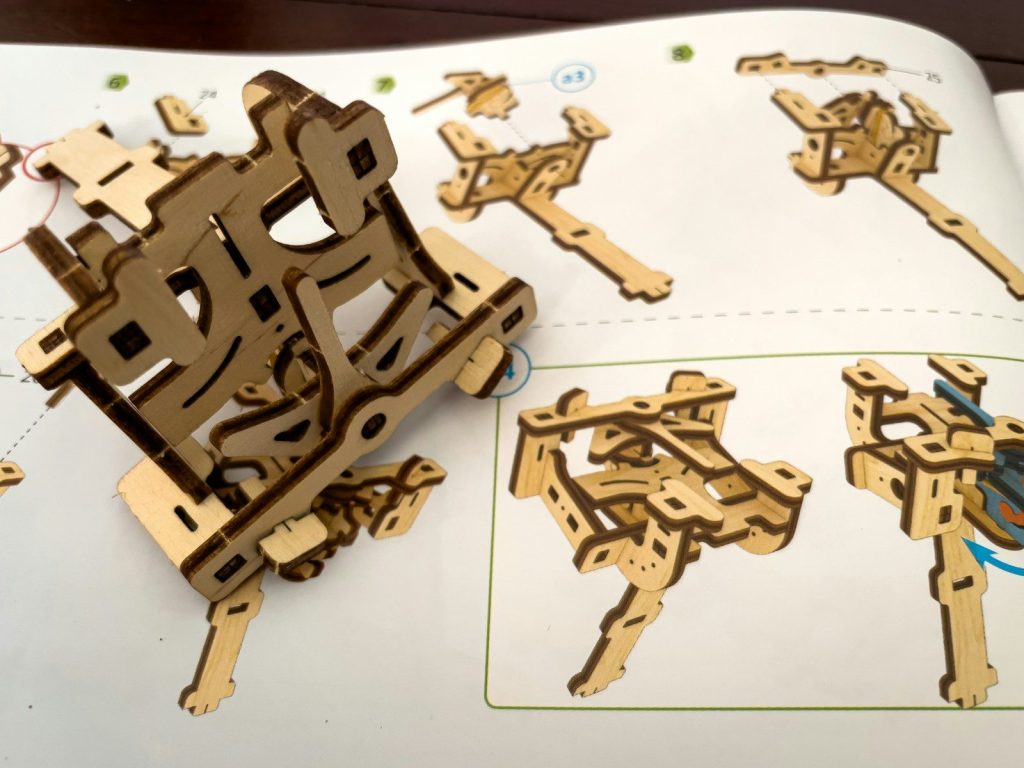
High-quality, translucent tiles offer a beautiful way to explore light and color theory.
The Intersection of Science and Art: Light and Color Theory
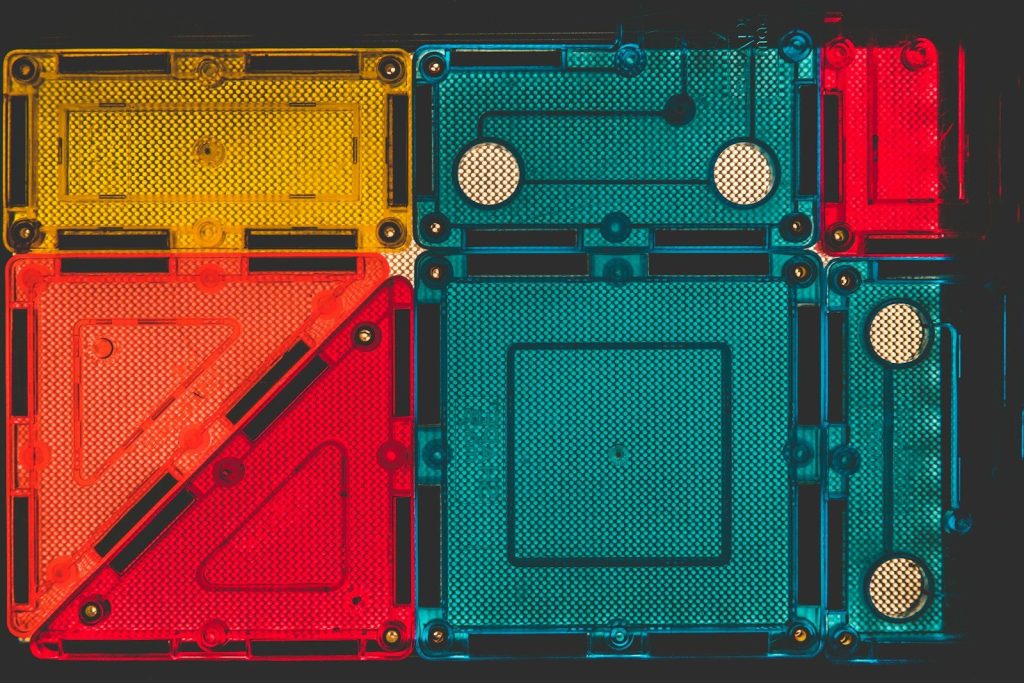
While the structural benefits are significant, magnetic tiles for kids STEM also provide a vibrant canvas for artistic exploration. Most high-quality tiles are made from translucent, food-grade ABS plastic in a rainbow of colors. When placed near a window or on a light table, these tiles become a medium for exploring Optics.
Exploring Refraction and Color Mixing
Children can observe how light passes through the tiles, projecting colorful patterns onto the floor—a simple yet effective demonstration of light refraction. By overlapping a blue tile and a yellow tile, they see green emerge, providing a hands-on lesson in subtractive color theory. This fusion of science and art (often referred to as STEAM) ensures that children remain engaged by the aesthetic beauty of their creations while simultaneously learning the rigid principles of geometry. It fosters an appreciation for design that is just as important in UI/UX design as it is in traditional architecture.
What to Look for in High-Quality Magnetic Tiles
Because these tiles are designed for heavy, daily use, safety and durability are the top priorities. When selecting magnetic tiles for kids STEM for your home or classroom, prioritize the following technical specifications:
- Ultrasonic Welding and Metal Rivets: Safety is non-negotiable. High-quality tiles use ultrasonic welding to seal the plastic and metal rivets to secure the corners. This dual-layer protection ensures the small magnets are permanently encased, preventing them from ever falling out—a critical safety requirement.
- High-Grade Neodymium Magnets: The “strength” of the build depends on the magnets. Look for sets that use larger, N35 or higher grade neodymium magnets. Stronger magnets allow children to build much larger, more stable structures and gravity-defying overhangs without the walls collapsing prematurely.
- Food-Grade ABS Plastic: Since these tiles are handled constantly, ensure they are made from non-toxic, BPA-free, and phthalate-free plastic. The surface should be scratch-resistant, and the edges should be smooth and rounded for comfortable, long-term play.
- Internal Bracing: Quality tiles often feature a “cross” or “star” bracing pattern inside the plastic. This not only makes the tile stronger but also helps reflect light more beautifully.

The ability to build tall, stable towers fosters a sense of accomplishment and technical pride.
Developing Executive Function and Collaborative Skills
Beyond the physical and mathematical lessons, magnetic tiles for kids STEM are incredible tools for developing “soft skills.” When children build in groups, they must communicate their vision, negotiate for specific shapes, and collaborate to keep a large structure from tipping over. This mirrors the collaborative environment of a modern tech team working on a Node.js project or a complex TypeScript application.
Building complex structures also requires high-level Executive Function. Children must plan their build, manage their “inventory” of tiles, and regulate their emotions when a tower inevitably falls. This resilience—the ability to look at a collapsed pile of tiles and say, “I can build it better next time”—is perhaps the most valuable lesson of all. It is the same persistence required to debug a difficult line of code or optimize a hardware performance system.
Conclusion: Empowering the Architects of Tomorrow
Magnetic tiles for kids STEM are more than just toys; they are essential instruments for discovery. They transform the home into a design studio where science, art, and engineering coexist. By providing your child with these colorful, magnetic tools, you are giving them the freedom to explore the invisible forces of nature and the solid principles of architecture. Whether they grow up to build physical bridges in Da Nang or digital frameworks for the global web, the journey begins with a single click of a magnetic tile. Start building today and watch your child’s imagination—and their technical skills—reach new heights!
Frequently Asked Questions (FAQ)
Q: What is the best age to start with magnetic tiles?
A: Most high-quality sets are safety-rated for children aged 3 and up. At this stage, children have the fine motor skills to snap the pieces together and the curiosity to explore the basics of 3D construction.
Q: Are different brands of magnetic tiles compatible?
A: Generally, yes. Most major brands of magnetic tiles for kids STEM use a standardized 3-inch (7.6 cm) base, allowing you to mix and match sets from different manufacturers. This modularity is perfect for expanding your “system” as your child’s engineering ambitions grow.
Q: How do I clean and maintain the tiles?
A: Simply wipe the tiles with a damp cloth and a mild, child-safe detergent. Never submerge the tiles in water, as moisture can eventually seep into the internal housing and affect the magnets or the clarity of the plastic.
Q: Can magnetic tiles help with color sorting?
A: Absolutely! They are a fantastic tool for teaching color recognition and sorting. Many educators use them to teach patterns and basic arithmetic, such as “how many squares does it take to build this tower?”
Q: Do these tiles break easily?
A: When made from high-quality ABS plastic with ultrasonic welding, they are incredibly durable. They are designed to survive the “crash” of a collapsing tower, though they should be protected from direct impact on extremely hard surfaces like concrete.
