Post, Pretend Play Toys
The Hidden Psychological Benefits of Pretend Play in Early Childhood
May
The Hidden Psychological Benefits of Pretend Play in Early Childhood
If you observe a group of young children playing, you will likely see them engaged in elaborate scenarios. One might be a doctor tending to a sick teddy bear, while another is a brave firefighter, and a third is a cashier ringing up groceries. To an adult, this looks like simple, adorable amusement; however, child psychologists view this as something much more profound. Engaging with pretend play toys is actually a critical developmental milestone that serves as the foundation for complex cognitive architecture.
Through the magic of make-believe, children are actively constructing their understanding of the world, developing complex psychological frameworks, and building essential life skills. In an era where passive screen time is rapidly replacing active play, understanding the deep psychological benefits of pretend play toys is crucial for every parent who wants to optimize their child’s developmental “runtime”. Pretend play allows children to process real-world situations in a safe, low-stakes environment, acting as a crucial bridge between their inner world and the external reality they are learning to navigate.

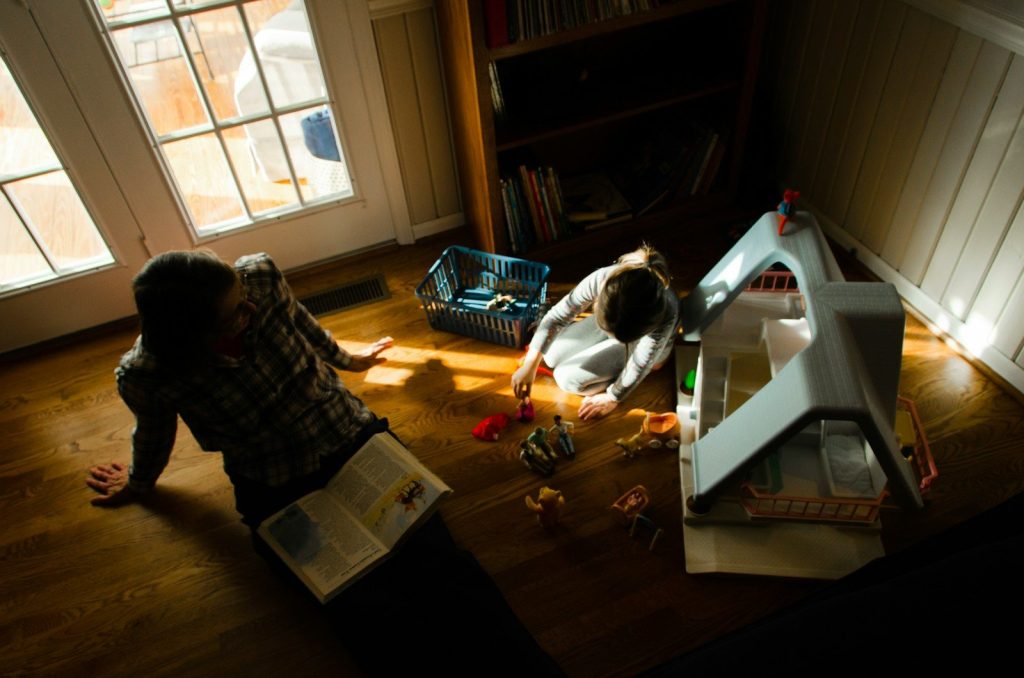
Pretend play allows children to process real-world situations in a safe environment.
What Exactly is Pretend Play? The Mechanics of Abstraction
Pretend play, often referred to as symbolic play or imaginative role-play, typically emerges around the age of **1.5 to 2.0 years old**. It is the biological process where a child uses an object to represent something else or takes on a persona outside of their own reality. It could be as simple as using a wooden block as a telephone, or as complex as setting up a full-scale imaginary restaurant using specialized pretend play toys.
The Cognitive Logic of Dual Realities
This type of play requires a sophisticated level of cognitive abstraction. The child must hold two distinct realities in their mind simultaneously: the literal reality (holding a plastic piece of food) and the imagined reality (cooking a gourmet meal). This mental flexibility is the foundation of advanced creative thinking and logical “mapping”. In cognitive terms, the child is practicing a form of mental “aliasing,” where one object is assigned a new set of properties and behaviors within a specific context.
This abstraction can be expressed as a mental function where the child maps a physical object ($P$) to a symbolic meaning ($S$):
$$f(P) = S$$
The ability to maintain this function without losing track of the physical world is what differentiates imaginative play from confusion. It is the beginning of the child’s ability to think about things that are not physically present—the same skill required for reading, mathematics, and complex software logic later in life.
The Psychological and Emotional Benefits: The Lab of Life
The value of pretend play toys extends far beyond keeping a child occupied. It serves as a safe psychological laboratory where children can test boundaries and learn social dynamics without real-world consequences.
1. Developing Empathy and Perspective-Taking
When a child puts on a costume or pretends to be a caring parent to a doll, they are practicing empathy. They must step outside their own egocentric worldview and consider how another person might feel or react. By acting out different roles using pretend play toys, they learn to understand diverse perspectives. This process of “emotional decentering” is a foundational skill for building healthy, compassionate relationships later in life. It is their first experience with “User Persona” modeling—learning to predict and respond to the needs of others.
2. Processing Anxiety and Stress: The Simulation Patch
Children often lack the sophisticated vocabulary to articulate their feelings, particularly negative ones like fear or frustration. Pretend play toys offer a vital therapeutic outlet. If a child is nervous about an upcoming medical checkup, playing with a toy doctor kit allows them to “take control” of the situation. By becoming the “Admin” of the medical scenario, they demystify the scary tools and process their fear in a safe, controlled environment. Play is, quite literally, a child’s natural language for “patching” their emotional state.

Props and themed toys make imaginative scenarios feel more authentic and engaging.
3. Boosting Executive Function and Self-Regulation
During cooperative role-play, children must agree on a scenario and follow the unspoken “rules” of that reality. If they are playing “supermarket” with a toy cash register, the “cashier” must wait for the “customer” to bring the items. This requires immense self-regulation and impulse control, which are heavily trained through the use of structured pretend play toys. They are learning to manage their “internal state” and adhere to a shared social protocol, which is critical for their future success in collaborative environments.
This social logic mirrors a basic transaction protocol:
- Request: Customer presents item.
- Processing: Cashier scans item.
- Exchange: Customer provides payment.
- Finalization: Transaction complete.
When a child masters this sequence in play, they are developing the neurological pathways for executive function—the mental processes that enable us to plan, focus attention, and juggle multiple tasks successfully.
Expanding Vocabulary and Linguistic Skills
Listen closely to a child engaged in imaginative play; you will often hear them using words and complex sentence structures they rarely use in everyday conversation. When playing with pretend play toys, they mimic the professional and social language of the adults around them. A child playing with a toy kitchen might use specific words like “simmer,” “ingredients,” or “delicious,” stretching their linguistic boundaries to fit the narrative they have created.
This linguistic expansion is more than just learning new words; it is about learning Contextual Syntax. They learn that certain words belong to certain “libraries” (e.g., medical words for the doctor kit, mechanical words for the tool bench). This ability to adapt language to a specific context is a hallmark of an articulate and communicative individual.
Choosing the Best Tools: Wooden vs. Plastic Hardware
When selecting the “hardware” for your child’s pretend play sessions, the material can influence the quality of the discovery experience.
| Feature | Wooden Pretend Play Toys | Plastic Pretend Play Toys |
|---|---|---|
| Durability | High; eco-friendly and long-lasting. | Moderate; can handle spills easily. |
| Realism | Tactile and classic. | High; includes lights and sounds. |
| Safety | Non-toxic; often heirloom quality. | Must be BPA-free; safety-tested. |
| Aesthetics | Timeless and minimalist. | Vibrant and detail-oriented. |
Conclusion: The Essential Work of Play
The next time you see your child immersed in a world of make-believe, recognize that they are doing the essential work of growing up. By supplying them with diverse, engaging pretend play toys, you are providing them with the emotional, cognitive, and linguistic tools they need to become empathetic, resilient, and articulate adults. Encourage their imagination, participate in their stories, and watch their incredible minds flourish as they map the invisible frontier of their own potential!
Frequently Asked Questions (FAQ)
Q: At what age should I start buying pretend play toys?
A: Most children begin to enjoy symbolic play around **18.0 months**. Simple items like play food or dolls are great starters, while more complex sets like tool benches or cash registers are ideal for ages **3.0 and up**.
Q: Are wooden pretend play toys better than plastic ones?
A: Wooden toys are often more durable and eco-friendly. Plastic toys can offer more realistic details like lights and sounds. Both are excellent for sparking imagination as long as they are non-toxic and safety-tested.
Q: Should I play along with my child?
A: Absolutely! Following your child’s lead in a pretend scenario is a fantastic way to bond and model positive social interactions. Just remember to let them be the “director” of the story so they can practice their autonomy!
Q: How can I encourage a child who seems less interested in pretending?
A: Try introducing themed props that align with their real-world interests (e.g., if they like the car, a “toy mechanic” kit). Start with simple, open-ended objects like cardboard boxes to lower the barrier to entry.
Q: Is there such a thing as “too much” pretend play?
A: Not usually. As long as the child can distinguish between the game and reality and is meeting other developmental milestones, imaginative play is a sign of a healthy, active mind.
