STEM & Creative Building Toys, Post
Gravitational Fun: Why Marble Run Sets are a STEM Essential
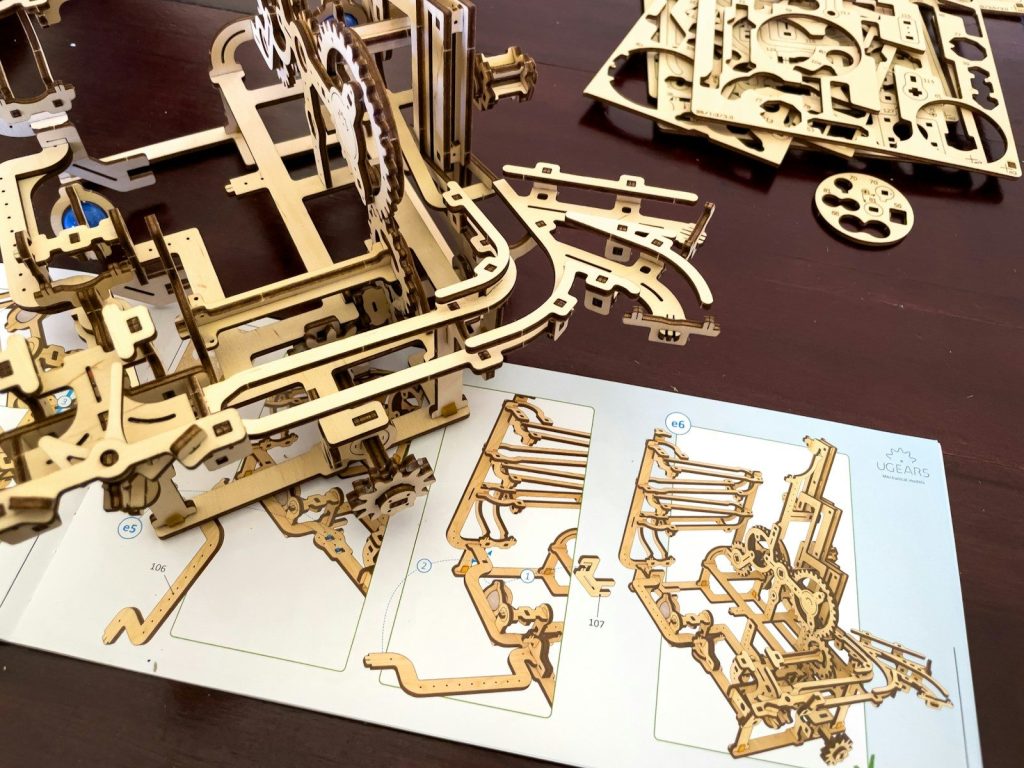
May
Gravitational Fun: Why Marble Run Sets are a STEM Essential
There is something undeniably hypnotic about watching a small glass marble navigate a complex labyrinth of twists, turns, and vertical drops. For decades, marble run sets for kids have been a staple in classrooms and playrooms alike. But beyond the sheer entertainment value, these sets are essentially a high-speed physics laboratory in disguise. They provide a hands-on environment where children can witness the invisible forces of the universe in action, turning “science time” into a thrilling race against gravity. In 2026, as educational standards increasingly prioritize practical inquiry over rote memorization, these tools have become indispensable for developing a child’s spatial and logical foundations.
A high-quality marble run set for kids is one of the best investments you can make for a child’s development. It is an open-ended toy that grows with the user, transitioning from simple straight tracks for toddlers to massive, multi-level structures that resemble professional roller coasters for older children. By engaging with these sets, kids don’t just “play”—honing the same iterative logic used in complex system optimization or application development, they “engineer”.
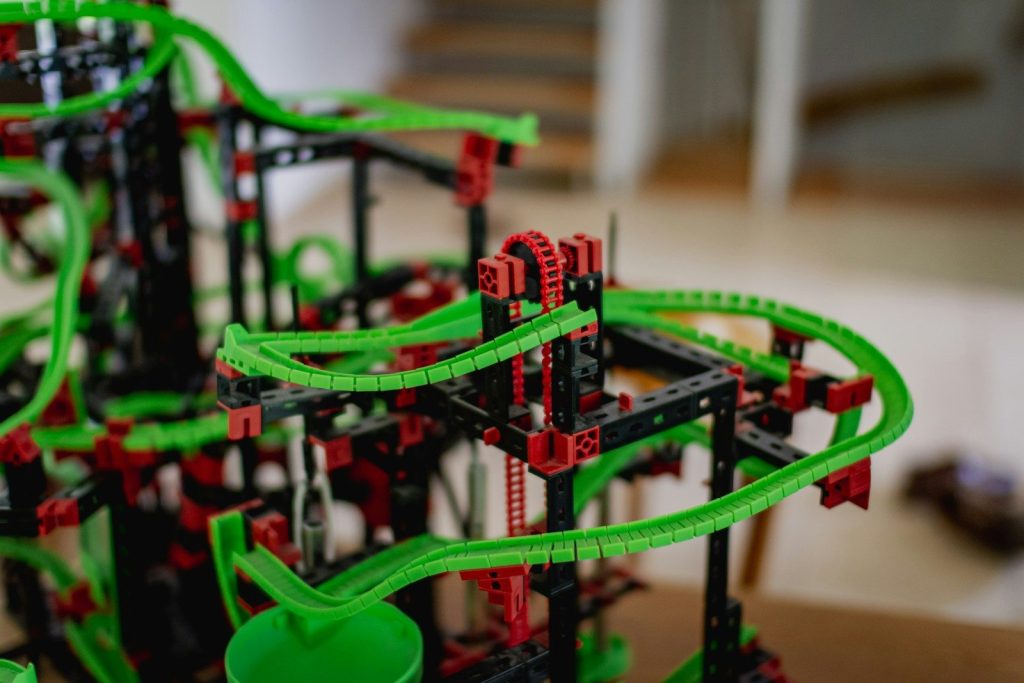
Marble runs turn the abstract laws of physics into a visible, high-speed adventure.
The Physics of the Roll: Understanding Energy and Momentum
Every time a child drops a marble into the starting funnel, they are initiating a complex sequence of energy transfers. Marble run sets for kids are the perfect tools to teach the fundamental concepts of classical mechanics without the need for a dry textbook. The track becomes a live-action demonstration of how the universe handles motion.
1. Potential vs. Kinetic Energy
The core principle at play is the conversion of Gravitational Potential Energy ($E_p$) into Kinetic Energy ($E_k$). Children quickly learn that the higher they build their starting point, the more “power” the marble has to complete the track. The mathematical relationship governing this is:
$$E_p = mgh$$
Where $m$ is the mass of the marble, $g$ is the acceleration due to gravity, and $h$ is the height. By increasing $h$, kids are effectively “debugging” their track to ensure the marble has enough velocity to overcome obstacles or loops further down the line.
2. Gravity, Friction, and Acceleration
As the marble descends, it accelerates. However, it also faces friction—the resistance encountered when the marble’s surface touches the track. Through trial and error, children discover why a marble slows down on a long horizontal stretch and speeds up on a steep drop. They begin to understand that the texture and cleanliness of the track directly affect the overall speed and success of the run.
3. Centripetal Force and Momentum
When a marble whirls around a funnel or a sharp U-turn, it demonstrates centripetal force. This is the “center-seeking” force that keeps the marble moving in a curved path. For older kids, this provides an introduction to angular momentum, explaining why the marble spins faster as it moves toward the center of a whirlpool funnel.
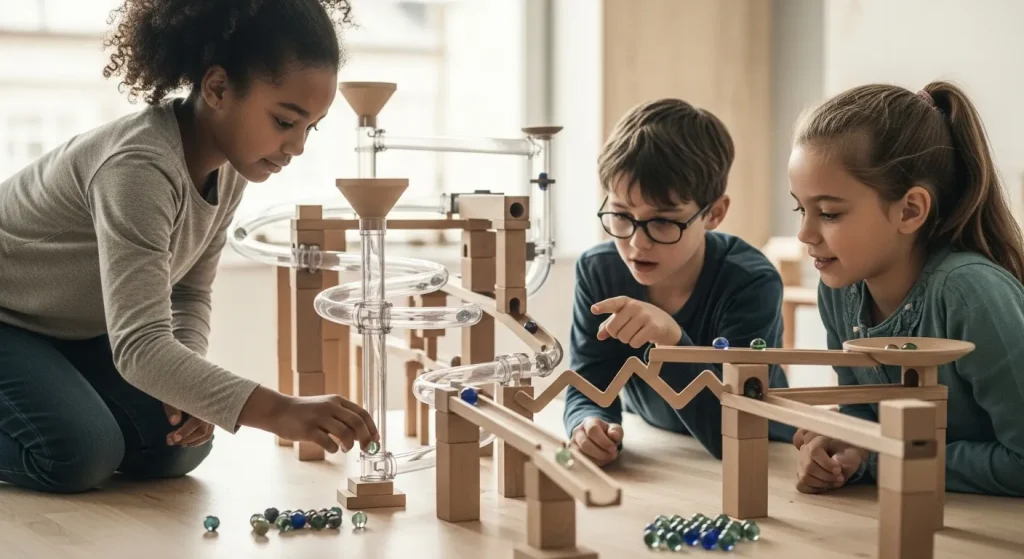
The excitement of a successful run is the ultimate reward for careful engineering.
Engineering Through “Debugging”: The Logical Cycle
Building a successful track is a masterclass in structural engineering. In the world of marble run sets for kids, “failure” is the most effective teacher. If a marble jumps off the track or gets stuck in a dead-end, the child must become a “mechanical detective,” applying the same troubleshooting logic used in software development or database management.
The Iterative Design Process
Just as a developer tests a new script, a child must test their track. They follow a specific logical cycle:
- Build: Constructing the initial architecture based on a mental map.
- Test: Releasing the marble to observe the system in motion.
- Analyze: Identifying exactly where the “bug” (the failure point) occurred.
- Iterate: Adjusting the angle, pillar height, or track piece to solve the problem.
This process builds incredible resilience. It teaches children that a “crash” is not a failure but an opportunity to improve the design. This mindset is essential for any professional career, whether they are building physical bridges or virtual frameworks.
Choosing the Perfect Marble Run Set: Material and Design
To ensure your child gets the most out of their gravitational experiments, it is vital to select a set that matches their developmental stage and interest level. At zixstory, we evaluate sets based on three primary criteria: stability, modularity, and engagement.
1. Stability and Structural Integrity
For younger children (ages 4–6), stability is paramount. Look for marble run sets for kids with wide, sturdy base pieces and interlocking tubes that click together securely. A tower that tips over at the slightest touch can lead to frustration rather than learning. As children get older, they can handle more delicate, free-standing block-based systems that require a steadier hand.
2. Translucent vs. Opaque Materials
Many modern sets use translucent (see-through) plastic. This is a game-changer for engagement. It allows the child to track the marble’s progress through every tube and tunnel, which is essential for visual tracking and identifying exactly where a marble might be losing momentum. It provides “transparency” to the system, much like monitoring real-time data in an application.
3. Modularity and Expansion
The best sets are part of a larger ecosystem. Look for brands that offer “booster packs” containing advanced components like loops, bells, elevators, or motorized lifts. This modularity ensures the toy remains challenging as the child’s engineering skills evolve, allowing them to build larger and more complex “versions” of their original designs.

Interlocking pieces allow for infinite configurations, keeping the engineering challenge fresh.
Wood vs. Plastic: Which is Better?
A common question among parents is whether to choose traditional wooden sets or modern plastic ones. Each has distinct advantages depending on the goal of the play session:
| Feature | Plastic Marble Runs | Wooden Marble Runs |
|---|---|---|
| Visuals | Often translucent; easy to see the marble. | Classic aesthetic; beautiful for display. |
| Complexity | Supports loops, jumps, and sharp curves. | Mostly relies on blocks and straight paths. |
| Stability | Interlocking; very hard to knock down. | Stackable; requires more precision. |
| Durability | Resilient; easy to wash. | Heirloom quality; long-lasting. |
Conclusion: Building the Future, One Marble at a Time
Marble run sets for kids are far more than just toys; they are engines for curiosity. They reward patience, encourage creative architecture, and provide a tangible way to explore the forces that govern our physical world. Whether they are building a simple 10-piece slide or a massive 150-piece skyscraper, your child is developing the critical thinking and logical reasoning skills they need to navigate the complexities of 2026 and beyond. At zixstory, we believe that the best way to learn is through the thrill of discovery. Grab a handful of marbles, clear the floor, and let the engineering adventure begin!
Frequently Asked Questions (FAQ)
Q: What is the ideal age to start playing with marble runs?
A: Most standard marble run sets for kids are designed for ages 4 and up. This is because standard marbles are a choking hazard. For younger children (ages 1.5 to 3), look for “Toddler Marble Runs” which feature extra-large balls and chunky, easy-to-grip pieces.
Q: Can I combine different brands of marble runs?
A: Generally, no. Most manufacturers use proprietary connector shapes and tube diameters. To build larger, more complex systems, we recommend sticking within a single brand ecosystem to ensure structural stability.
Q: Are marble runs good for children with ADHD or sensory needs?
A: Yes. The rhythmic sound of the marble and the predictable motion can be very soothing. Furthermore, the task of building provides a clear, goal-oriented activity that helps improve focus and executive function.
Q: How do I keep the marbles from getting lost under furniture?
A: We recommend playing on a hard floor or a low-pile rug rather than thick carpet. Additionally, look for sets that include a “collection tray” or “landing pad” at the end of the track to keep the marbles contained.
Q: How do I clean my plastic marble run?
A: Since they are usually made of high-quality plastic, you can wash them in a tub of warm, soapy water. This is particularly useful if the marbles seem to be slowing down due to dust or hair buildup inside the tubes.
